Free shipping on all international orders over £100

Last week, we stepped into the world of olfactory art with SCREEN, a fragrance-artwork created by JOUISSANCE founder Cherry Cheng and artist Ella Fleck. Inspired by Fleck's work on digital desire and disguise, the scent is solely available in unique artist-designed bottles.
To celebrate, we offered Fahad Mayet a page in our diary to dedicate to the pleasures of scented art. An independent nose, designer and creative producer, and the founder of Dean’s Bottom, a platform for artists, makers and writers working with smell, Fahad gives us an insider’s guide to the scent works now reaching the Venice Biennale, the Whitechapel Gallery and the toilets of Frieze London.
“I’m a bit of a pig.”
What does this answer really mean? It’s a terribly hackneyed thing to say in the circulating discourses of perfumery and olfactive artworks, but my sense of smell is my memory centre. I forget faces, paintings, installations, moving image, but a scent reference immediately triggers me, and my body feels like I am somewhere else – in the armpit of a lover, or walking aimlessly around hospital corridors grieving the loss of a grandparent. I’ve always perceived and remembered the world around me nose first.
Whilst the turn to using smells in conceptual art, found or created, is not new, there has been a resurgence of interest in this medium. We see it in commercial perfumery with an exponentially growing marketplace. We see it in the works emerging artists are making (often in collaboration with perfumers); notably, there were at least three artists showing olfactive work in the recent MFA graduate shows in London. And we see it in practices that our institutions are beginning to spotlight, from Cauleen Smith’s 'The Wanda Coleman Songbook' in Koyo Kouoh’s ‘In Minor Keys’ at the Venice Biennale to Adam Farah-Saad and Ezra-Lloyd Jackson’s ‘MOMENTATIONAL SCENT CHAMBER (E2NW9)’ at the Whitechapel Gallery. There has been something about our post-Covid condition that has made us acutely aware of the air we breathe, the molecules that inhabit it, and the chemical transformations we become participants in and receptacles of.
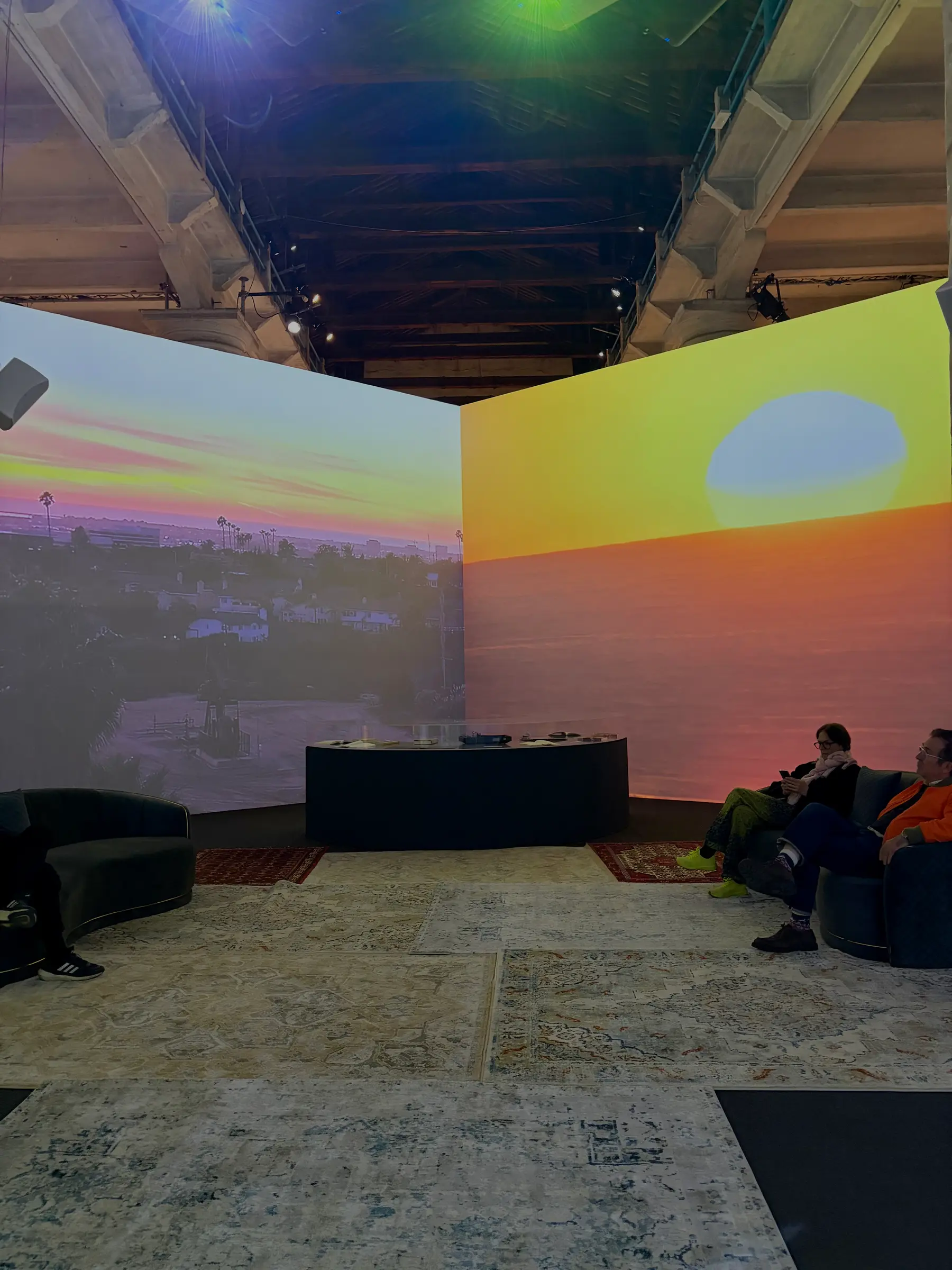
Cauleen Smith. ‘The Wanda Coleman Songbook’ in Koyo Kouoh’s ‘In Minor Keys’, 2024. Scent design: agustine zegers. Courtesy of Dean’s Bottom
I remember my first time visiting a show after Covid and perceiving smells in the exhibition space. It was Adam Farah-Saad’s exhibition WHAT I’VE LEARNT FROM YOU AND MYSELF (PEAK MOMENTATIONS / INSIDE MY VELVET ROPE MIX) at Camden Art Centre in autumn 2021. It was one of the first exhibitions I saw as we emerged from the lockdowns of the previous two years. Walking around the space looking at works mounted on racks made for displaying band posters in retail environments, I began to sense the familiar glow of something sweet and fruity. I didn’t think much of it, imagining I had caught a whiff of the perfume of another visitor.
The fountains at Brent Cross are obviously not using grape soda, but there is a curious material interplay in this work, with the artist working with the smell (and taste) of a soda they consume, bubbling away in a rusting structure, in conversation with the visuality referenced in the surrounding work: a print of an archival image of Brent Cross set against a record store CD stand and a fish-eye film of Farah-Saad cycling around nearby Staples Corner. Together in the exhibition, they created a potent and poetic psychogeographic documentation, the rusting fountain serving as our only cue to having fallen out of time.

Adam Farah-Saad. ‘T1M£ (The Endz Portorbital Alchemical Mix)’, 2021. Courtesy of the artist and CAPC Musée d_art Contemporain de Bordeaux
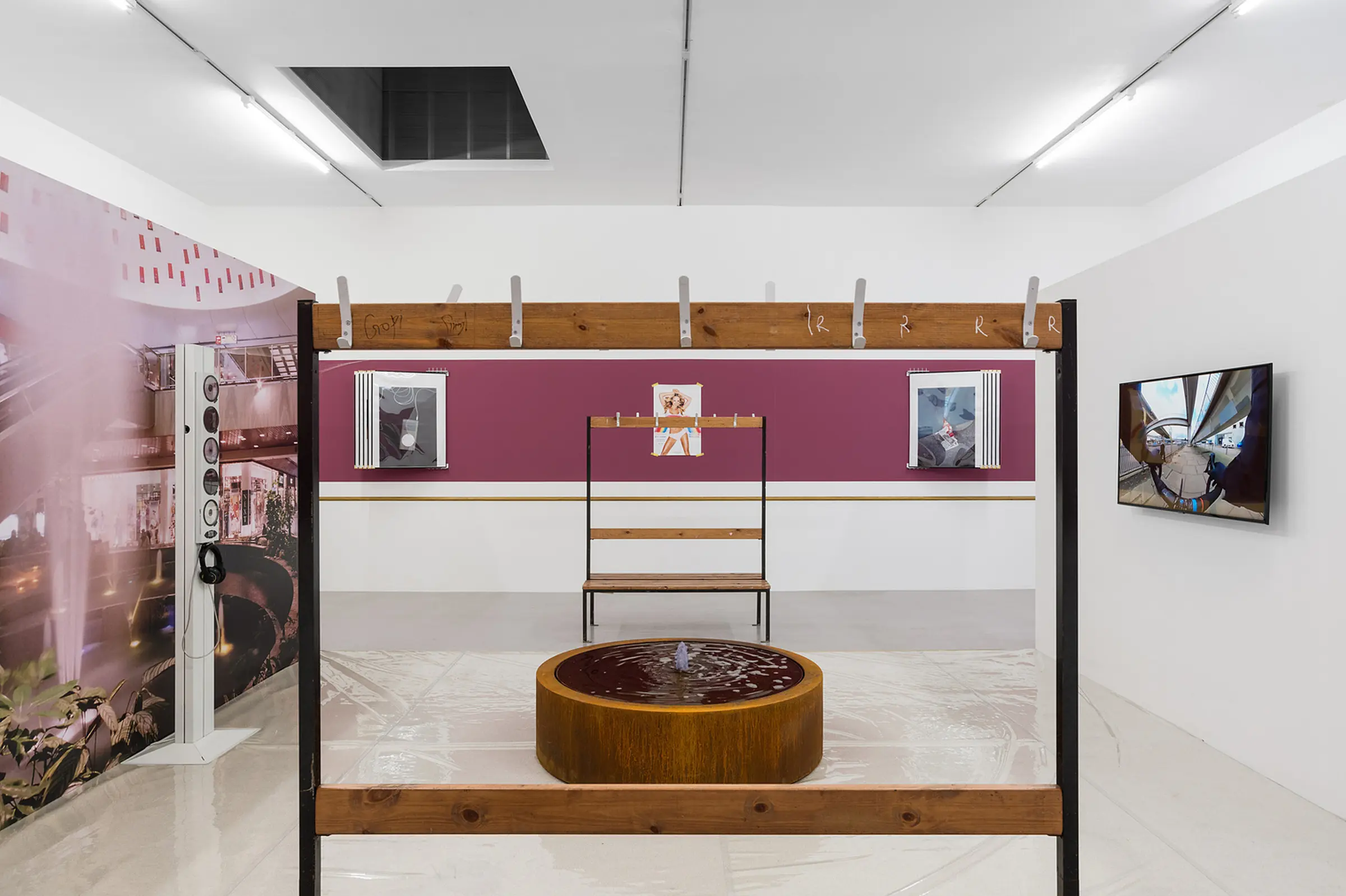
Adam Farah-Saad. WHAT I’VE LEARNT FROM YOU AND MYSELF (PEAK MOMENTATIONS _ INSIDE MY VELVET ROPE MIX), 2021. Install view at Camden Art Centre. Courtesy of the artist and Camden Art Centre

Ella Fleck. Spray, 2024. Install view. Courtesy of the artist and Season 4, Episode 6
I think about modes and methods of exhibiting olfactive works a lot. The form (or formless-ness) of scent is a key part of the conception and development process I undergo with artists in projects I am involved with.
The central work in the exhibition was an exposed HVAC system hanging from the ceiling, to me referencing the ducting sculptures of German minimalist Charlotte Posenenske. The ducting would, periodically and without warning, ‘spray’ out a thick fog into the gallery onto visitors. The fog was infused with androstenone, a pheromone commonly associated with encouraging breeding in industrial pig farming. The dense fog was an important and effective method of making visible something that the participants in the Discord community wanted to keep secret. The men in the community wanted to maintain a sort of power that invisibility can bring; Fleck exposed it not only in the concept of the exhibition but in the form that she gave the pheromones that she chose to distribute through the ducting.

Chinese boar odorant packaging
I don’t think all olfactive work needs to take tangible form, or be visible, but working with an object can also be materially rigorous and playful. Most recently, Dean’s Bottom, my platform for artists, makers, and writers working with smell, commissioned and produced ‘Production’, 2026, by Gray Wielebinski. This was an ambitious olfactive site-specific intervention across Frieze London’s bathrooms, into all 94 of its toilets and urinals. Especially developed urinal cakes and toilet rim blocks diffused a custom scent made in collaboration with perfumer Alina Miron, invoking the smells of Wielebinski’s studio – pencil shavings, paint, dust and sweat. Housed in cage-like forms, the deodoriser blocks explore the ways in which experiences of intimacy and safety in the public realm can be intensely surveilled and controlled.

Gray Wielebinski. Production, 2026. Scent design: Alina Miron, Fahad Mayet, and Gray Wielebinski. Commissioned and produced by Dean’s Bottom. Photo by Linda Nylind. Courtesy of Frieze

SCREEN by Ella Fleck & Cherry Cheng, Install view at APOC

"It was while writing a Diary that I discovered how to capture living moments," Anaïs Nin wrote. "In the Diary I only wrote of what interested me genuinely, what I felt most strongly at the moment, and I found this fervour, this enthusiasm produced a vividness which often withered in the formal work. Improvisation, free association, obedience to mood, impulse, brought forth countless images, portraits, descriptions, impressionistic sketches, symphonic experiments, from which I could dip at any time for material."
In tribute to Anaïs Nin, one of our foremost inspirations for Jouissance, our DIARY captures our most treasured moments, our obsessions and preoccupations, our research and the lessons we learn, and the work of our cherished friends and collaborators.
