Free shipping on all international orders over £100
Though undoubtedly something of a spectacle, the act of applying perfume is usually better done at a tactful distance from others. Spritzing your signature scent in the office or a packed cocktail bar is at best eccentric, at worst anti-social.
Still, there’s something entrancing about a woman performing beauty rituals in public – an intimate glimpse into the process, not just the finished product. It sparks a frisson of oversharing that recalls a lost form of exhibitionism, before social media, before the boundaries between public and private life dissolved. In this small act lies a subtle message, a declaration of presence. To anoint oneself in public is to acknowledge one's awareness of being seen – and to choose what to reveal.
The association between daring self-expression and public preening became more visible during the roaring twenties. Imagine a woman using a compact, the archetypal image is probably a flapper: bobbed or shingled hair and stockings rolled down to her knees. The trend coincided with the early 20th century’s proliferation of portable make-up compacts – but whereas other women might discreetly check their reflections in a quiet corner, the flapper broke with convention, applying her (deliberately artificial) make-up in full view of the room.
The flapper’s penchant for public painting spoke volumes. At times, it bolstered the subculture’s characteristic air of cultivated ennui, witnessed by the reader in all its languid and leisurely detail in ‘The Ice Palace’, a short story from F. Scott Fitzgerald’s 1920 collection, Flappers and Philosophers:
At others, it was a statement of sexual freedom. In a scene from FW Murnau’s silent film Sunrise (1927), the evil, flapper-coded ‘Woman from the City’ uses a compact seconds before meeting a married man – a performance designed to seduce him away from his less sophisticated, natural-faced wife.
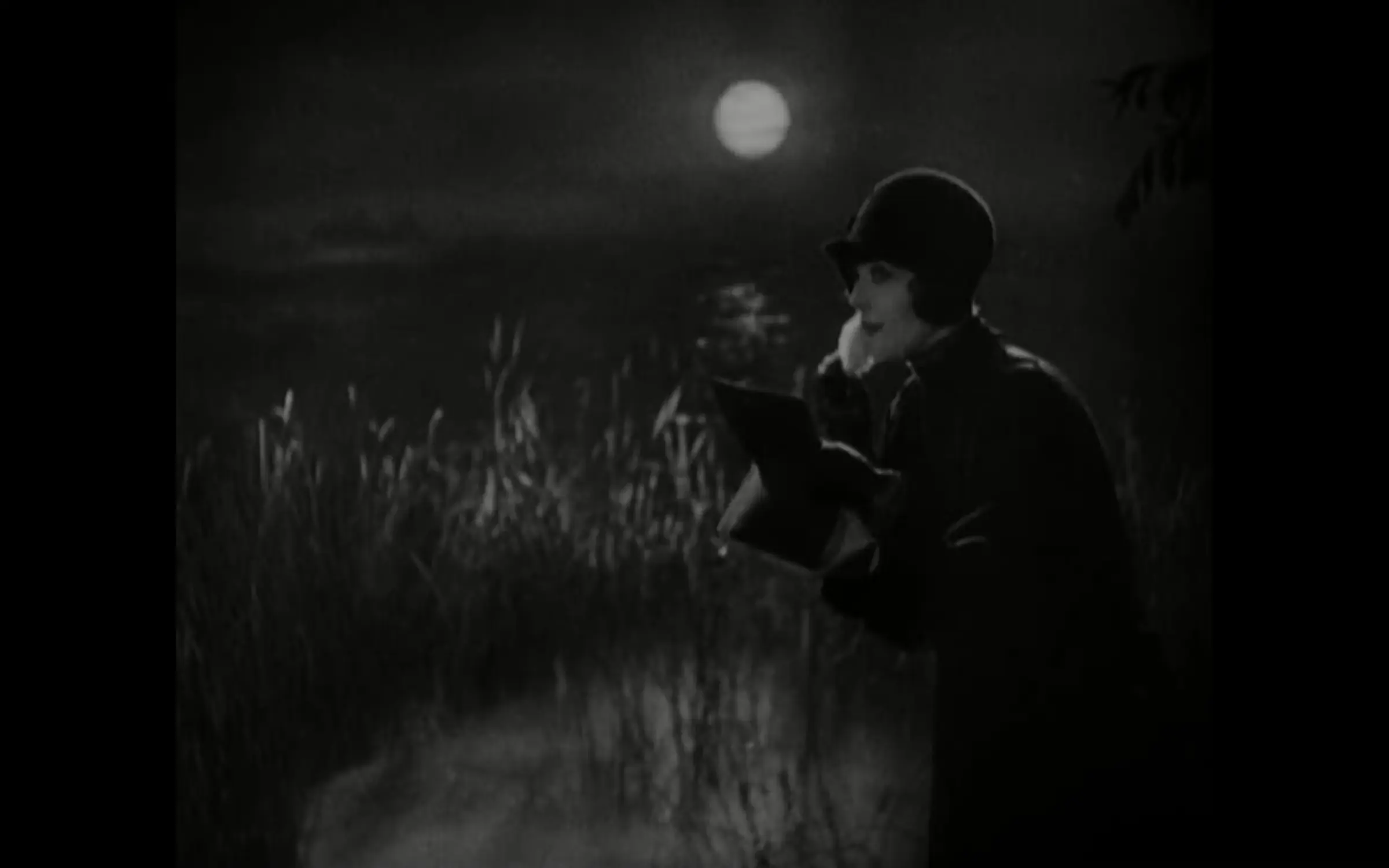
Sunrise (1927)
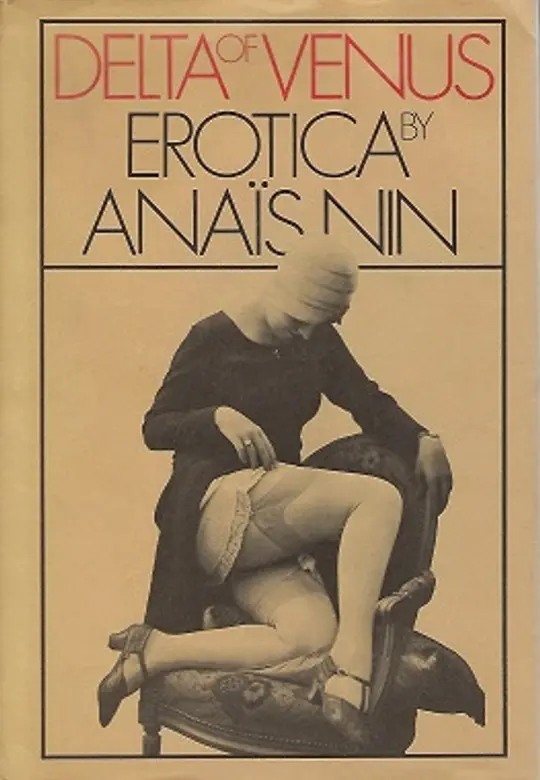
There’s no make-up scene more provocative than the one in Anais Nin’s ‘The Hungarian Adventurer’, easily one of the most shocking and subversive short stories in Delta of Venus. In it, the perverted protagonist ‘The Baron’ visits a famously beautiful dancer in her dressing room, where he finds her “rouging her sex with her lipstick” in front of a group of admirers.
“When the Baron came in she merely lifted her head and smiled at him. She had one foot on a little table, her elaborate Brazilian dress was lifted, and with her jewelled hands she took up rouging her sex again, laughing at the excitement of the men around her.”
It’s a description that delights in its audacity as well as its eroticism: a woman using make-up to assert control over a roomful of men. As Nin notes, while they watch they are not permitted “to make a single gesture towards her”, making clear the power she wields in her own carefully staged performance.
A similar power struggle can be seen in Mike Nicols’ 1988 film Working Girl, though here between two women. Katharine Parker, a ruthless executive on wall street played by Sigourney Weaver, prepares for a meeting with her lover in front of her assistant, Tess (Melanie Griffiths). Dressed in lingerie and daubing her neck from a bottle of Guerlain’s Shalimar, she casually displays the privileges that come with status and wealth, showing that erotic and professional power are closely intertwined – and reminding Tess of her place at the same time. Tess gets the better of Katharine in the end, but it’s still this image of feminine authority that lingers long after the credits have rolled.
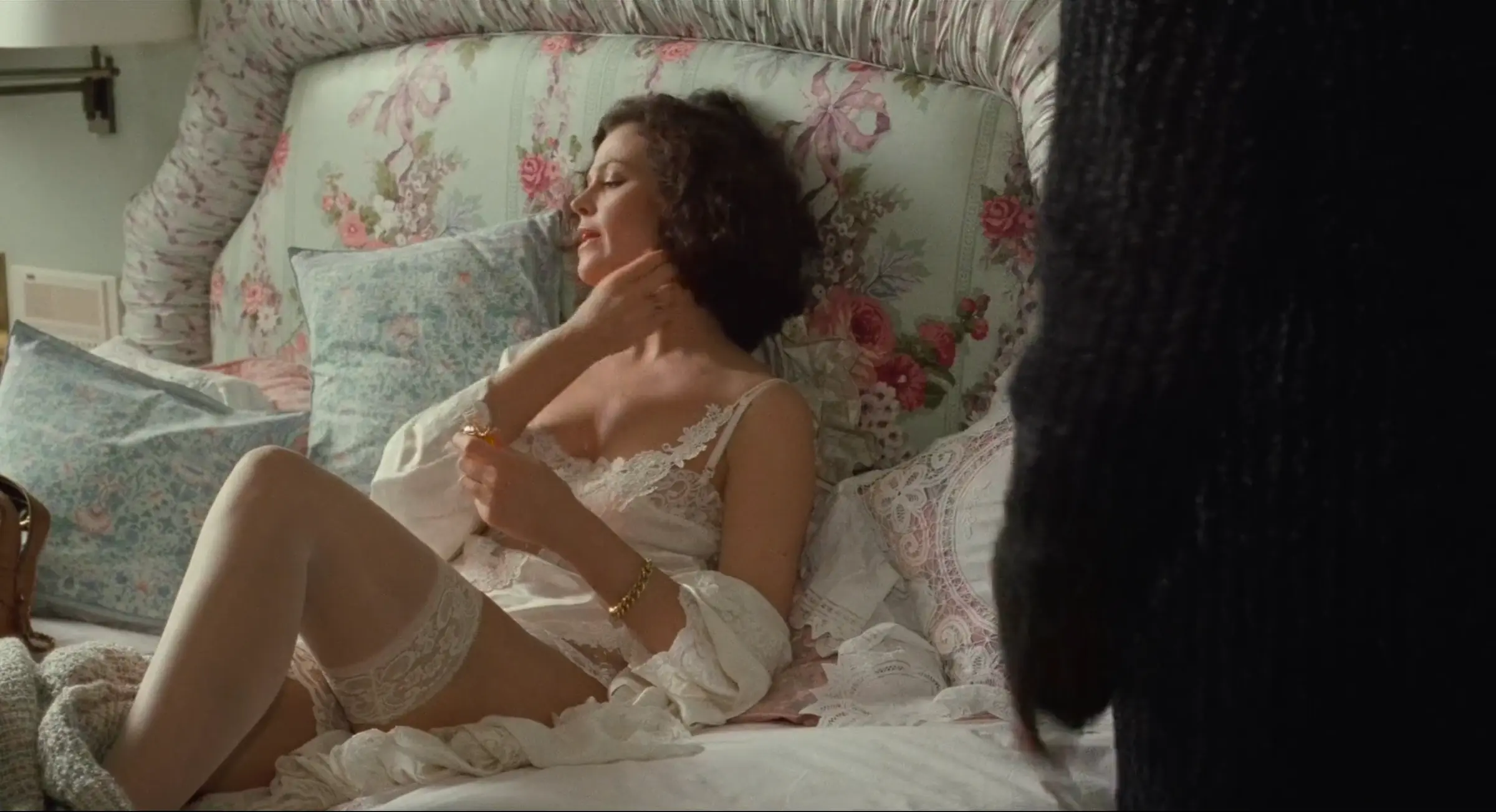
Working Girl (1988)
“Never complain, never explain.” So goes the motto adopted from two-time prime minister Benjamin Disraeli by the Royal family. Perhaps that’s why Queen Elizabeth II chose to speak with her make-up. At public events, she would take her lipstick out of her bag and apply it, which reportedly signalled to her ladies-in-waiting that she was ready to leave. She became so practiced that she could do it without the need for a mirror.
This regal make-up message recalls another member of a royal court – mistress of King Louis XV of France Madame Pompadour – who used her dressing table as a stage from which she could charm her allies, garner influence and be admired. Margaret Trouncer's 1956 book, The Pompadour, describes her morning ritual:
“She awoke, put on a fresh chemise, then a blue morning jacket, and was placed in front of her mirror. Never would she consider receiving her coterie without being made up at a preliminary toilette. This was a hasty session, in which her hair was brushed and enough cosmetics applied to make her presentable. When her guests arrived around one o'clock, she was still en déshabillé, while her maid dusted her hair with blue-white powder."
Famously influential at court, despite only being a mistress, not a wife, Pompadour surely owes some of her power to the sense of flattery felt by those invited into her private sphere. The grooming motif was one that she also performed in public life, in the theatre des petits appartments of Versailles, where she loved to play the part of Venus at her toilette. The famous Rococo portrait of Pompadour at her dressing table by Boucher plays with the same motif. She gazes back at the viewer, interrupted in the act of applying powder to her face, communicating to the world her status as the ideal mistress – an expert in the courtly ideals of beauty, taste, and comportment.
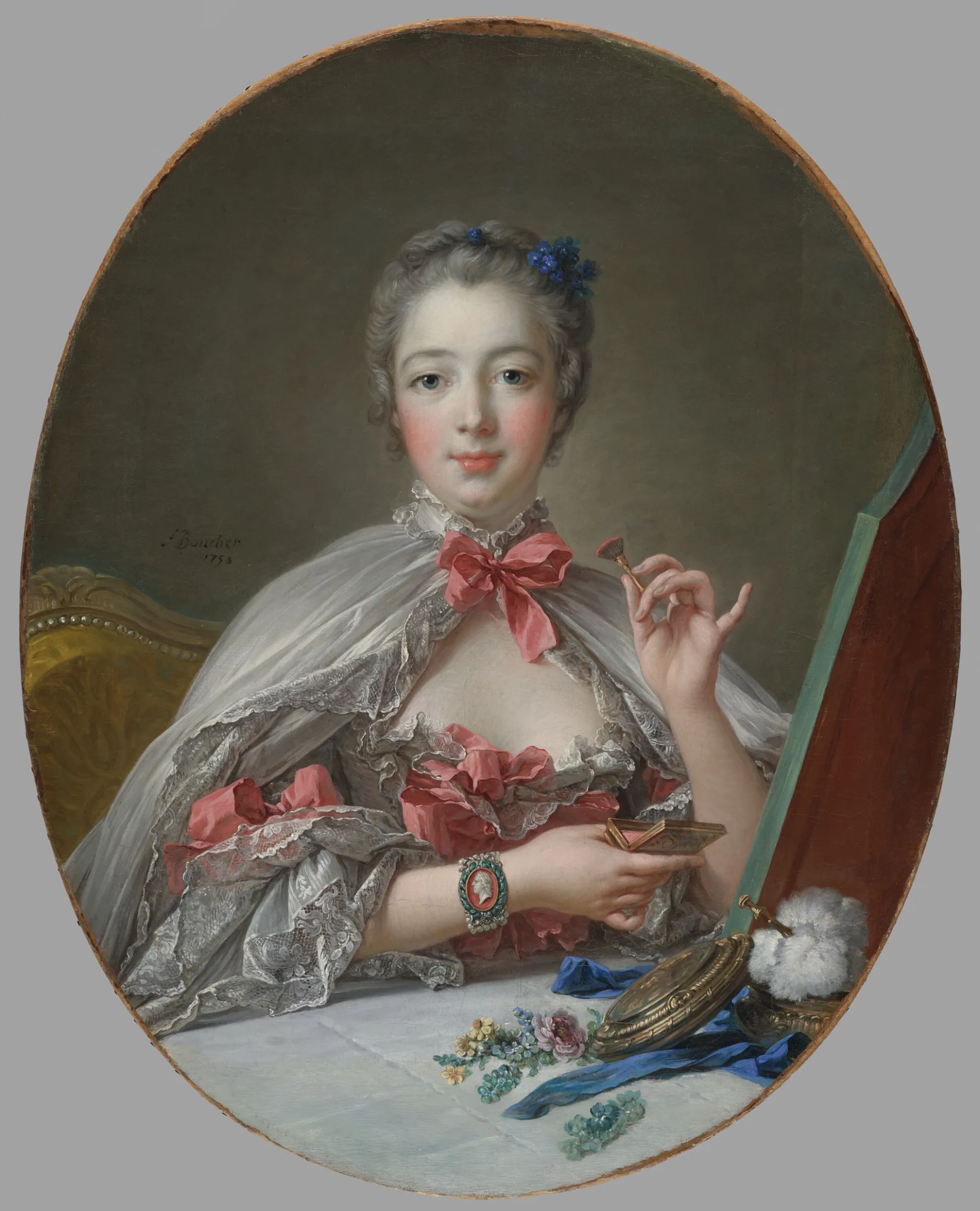
‘Pompadour at her Toilette’, François Boucher, 1750 (with later additions)
Queens have historians to interpret each and every public appearance, but for the rest of us, messages can sometimes be mistranslated. There’s a moment in François Sagan’s La Chamande where make-up is the source and symbol of a miscommunication between lovers: ‘'Diane's legend, that of being invulnerable and unrestrained, was too well-known in Paris and he had heard it told repeatedly. For a second, they just missed knowing each other. Then she opened her handbag, took out a gold vanity case and touched up her face. It was the gesture of a panic-stricken woman, but he mistook it for a gesture of indifference.”
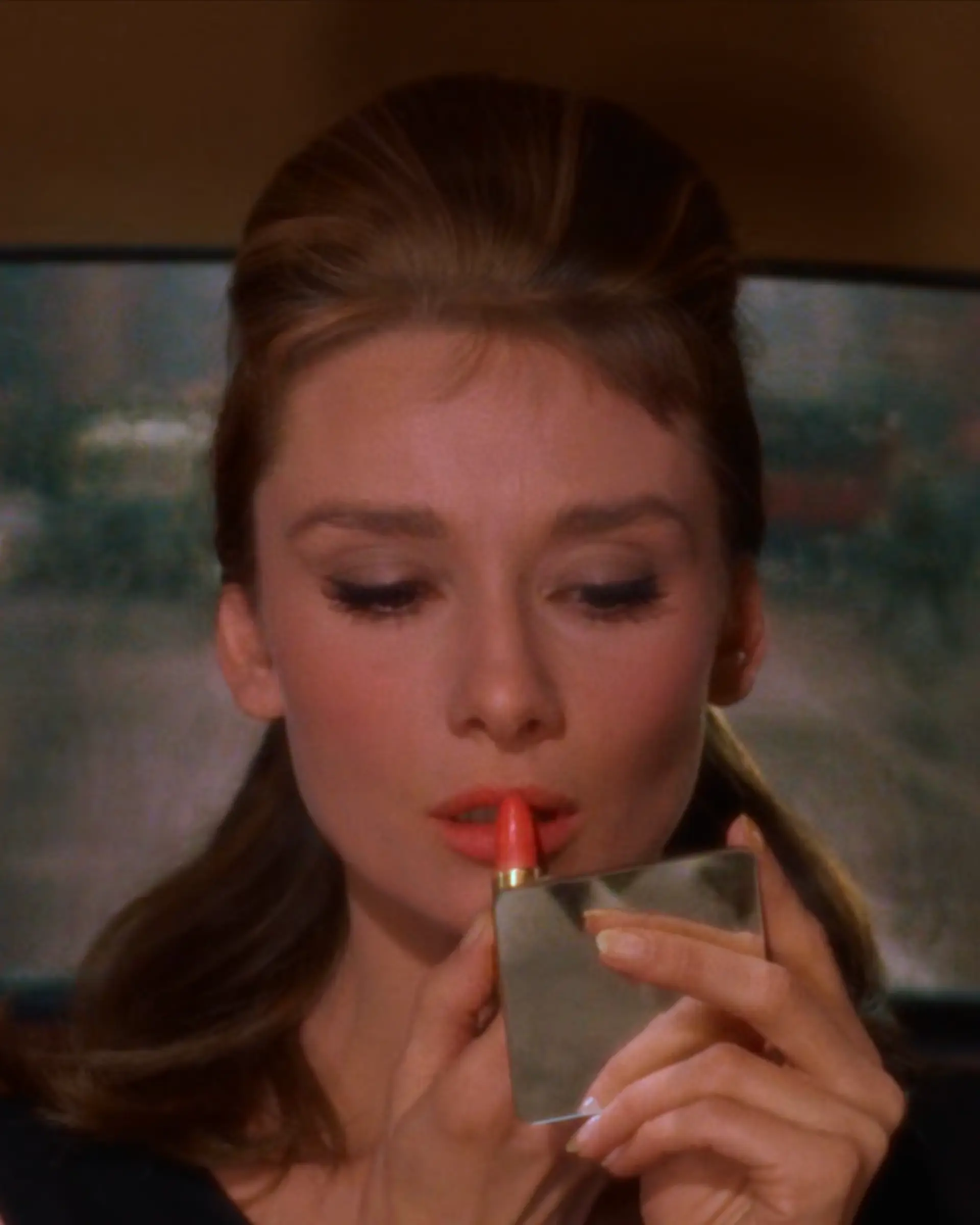
In Breakfast at Tiffany’s, a similar blur exists between fragility and bravado. Each time the unnamed narrator observes Holly Golightly putting on her make-up, it serves as a shield against her precarious reality, allowing her to inhabit the glamorous, carefree persona of a New York party girl.
“The instant she saw the letter she squinted her eyes and bent her lips in a tough tiny smile that advanced her age immeasurably. "Darling," she instructed me, "would you reach in the drawer there and give me my purse. A girl doesn't read this sort of thing without her lipstick."
Guided by a compact mirror, she powdered, painted every vestige of twelve-year-old out of her face. She shaped her lips with one tube, colored her cheeks from another. She penciled the rims of her eyes, blued the lids, sprinkled her neck with 4711; attached pearls to her ears and donned her dark glasses; thus armored, and after a displeased appraisal of her manicure's shabby condition, she ripped open the letter and let her eyes race through it while her stony small smile grew smaller and harder.”
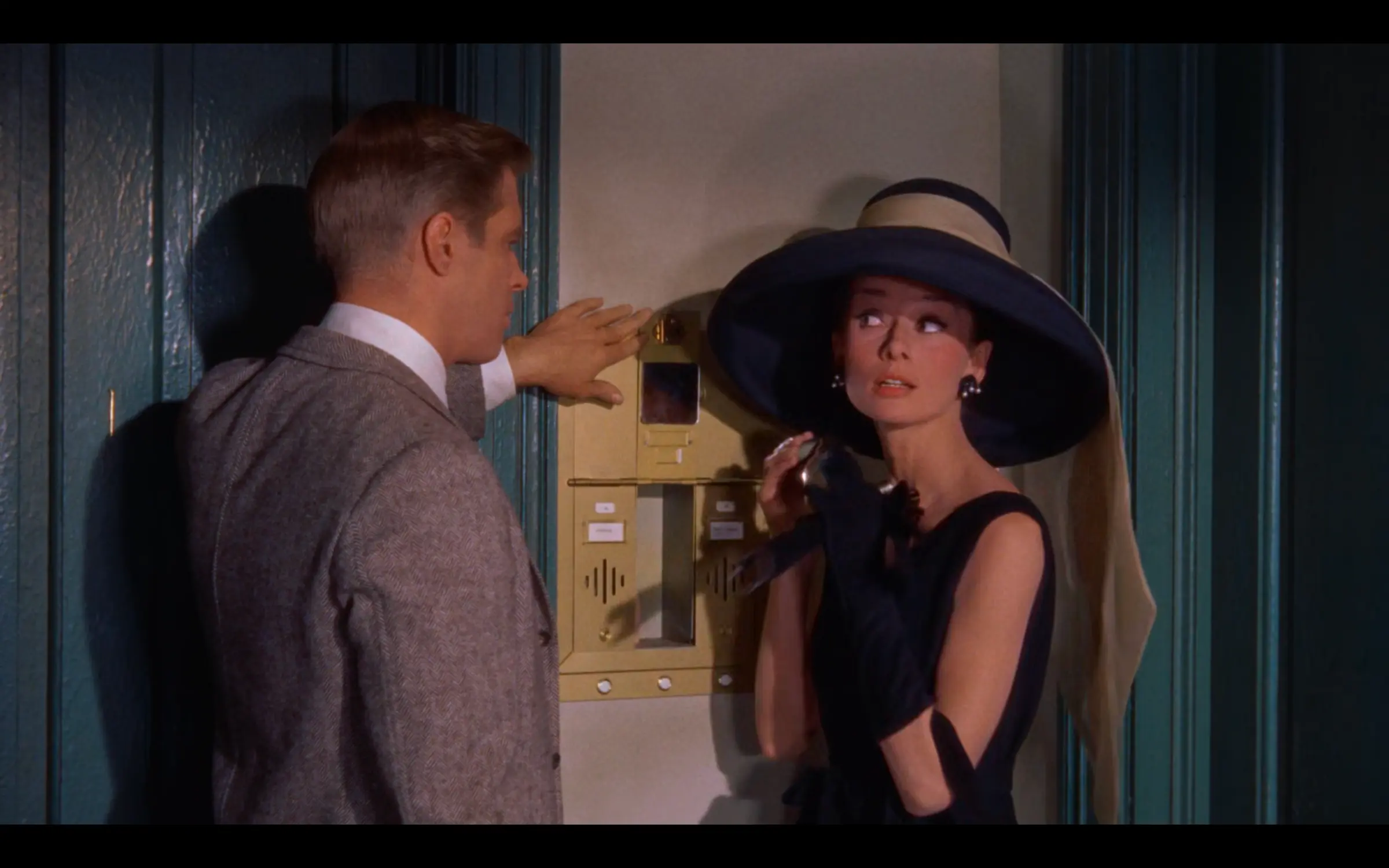
In Blake Edwards’ film adaptation, Holly’s dressing table (the postbox containing a mirror, lipstick and a bottle of perfume) lives in the liminal space between her apartment and the street, allowing her a final coat of armor against the world. A last-minute protective ritual witnessed only by those close to her.
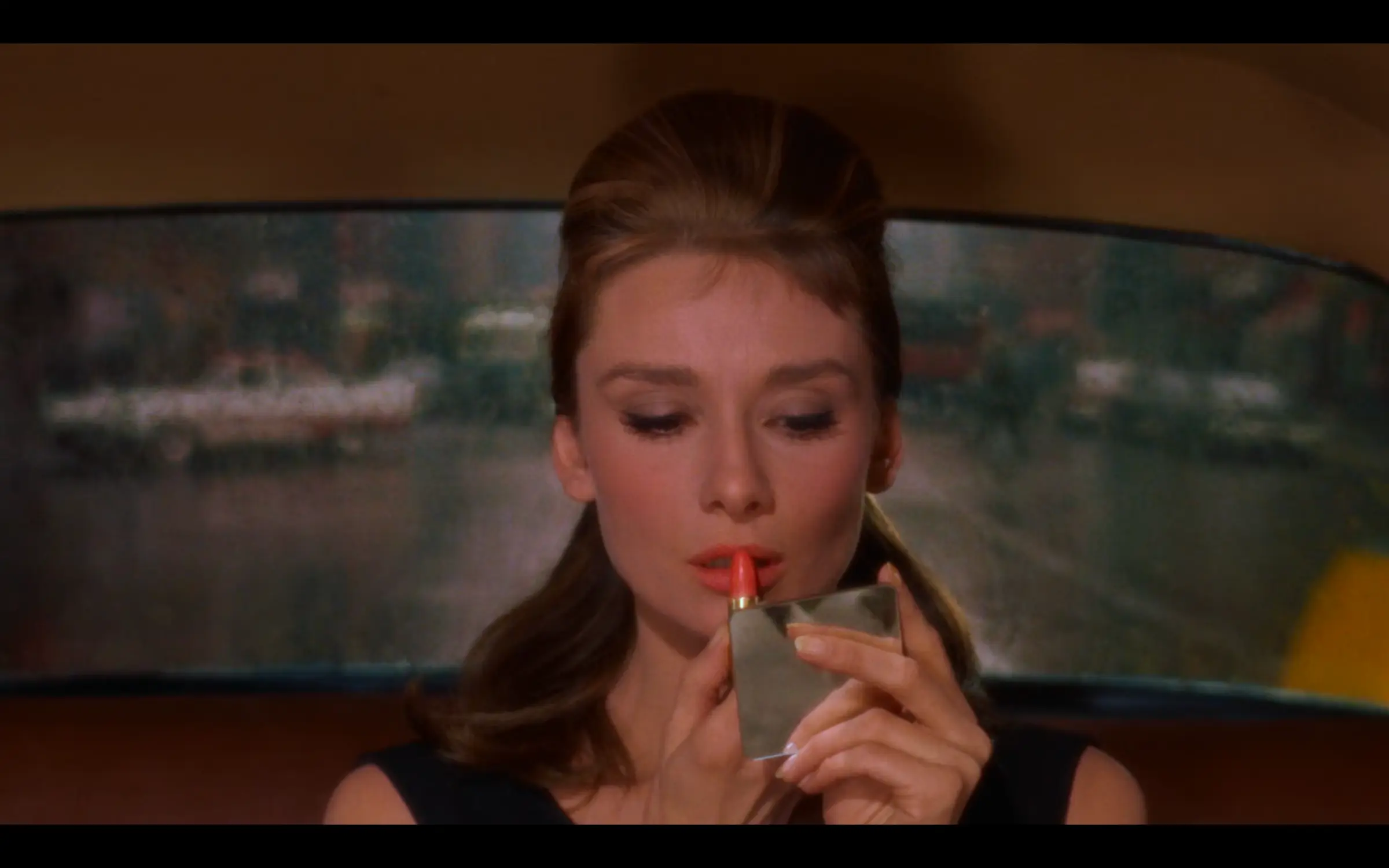
When it comes to getting ready in front of someone else, the watcher can be just as important as the star. The link between cosmetics and seduction is never far away. In her song, ‘Off to the Races’, Lana Del Rey describes the show she puts on for her lover, getting ready in the shared space of the hotel room.
Likes to watch me in the glass room, bathroom, Chateau Marmont
Slippin' on my red dress, puttin' on my makeup
Glass room, perfume, cognac, lilac fumes
Says it feels like heaven to him
A reminder that the most effective beauty rituals can sometimes be those we perform for a chosen audience of one.
portable, precise, personal.
A dusting of powder on flushed skin.
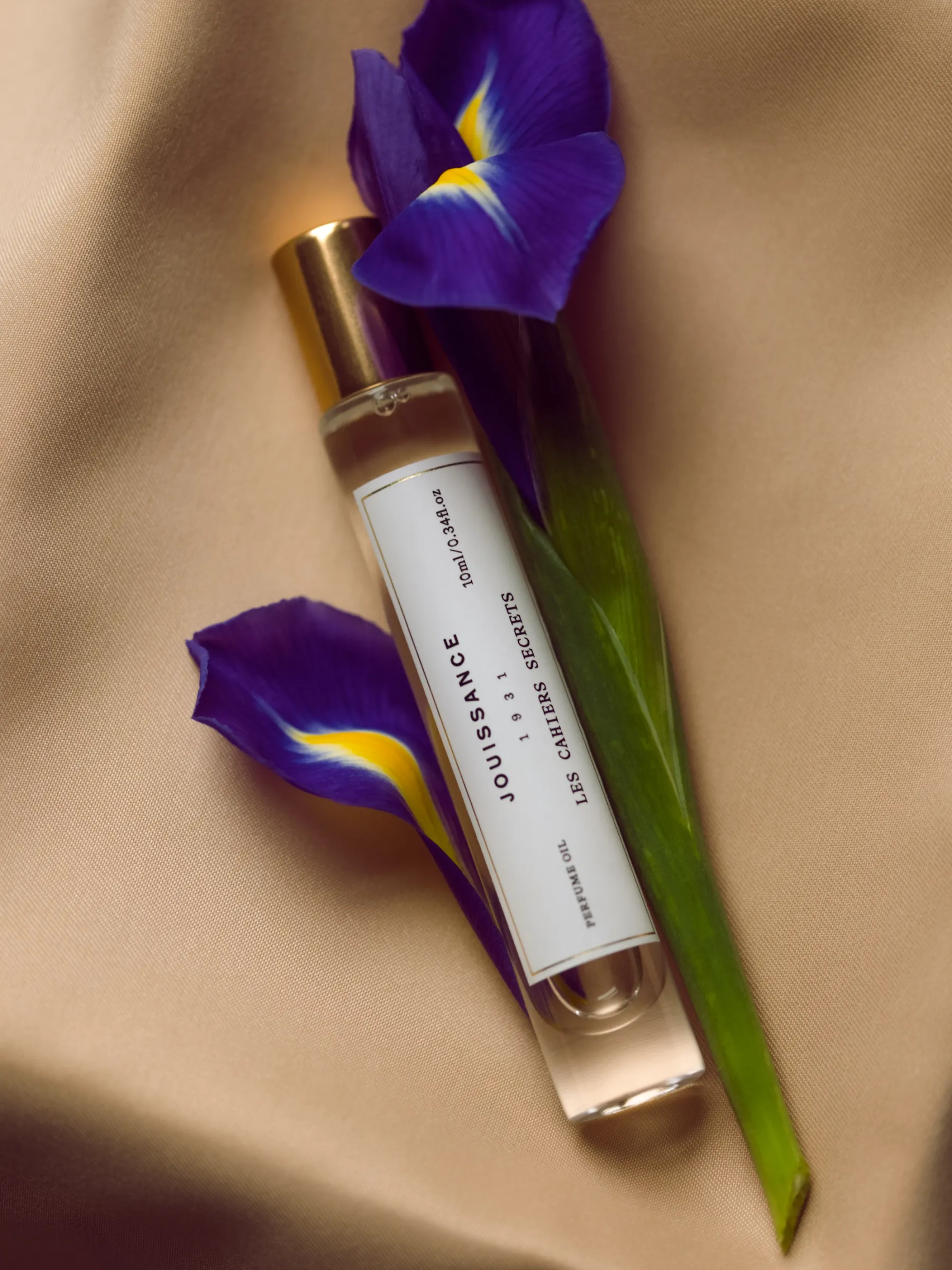
"It was while writing a Diary that I discovered how to capture living moments," Anaïs Nin wrote. "In the Diary I only wrote of what interested me genuinely, what I felt most strongly at the moment, and I found this fervour, this enthusiasm produced a vividness which often withered in the formal work. Improvisation, free association, obedience to mood, impulse, brought forth countless images, portraits, descriptions, impressionistic sketches, symphonic experiments, from which I could dip at any time for material."
In tribute to Anaïs Nin, one of our foremost inspirations for Jouissance, our DIARY captures our most treasured moments, our obsessions and preoccupations, our research and the lessons we learn, and the work of our cherished friends and collaborators.